Project News / Commercial
Austin Weighs $6.35 Million Utility Deal for 260-Acre Winding Trails Development
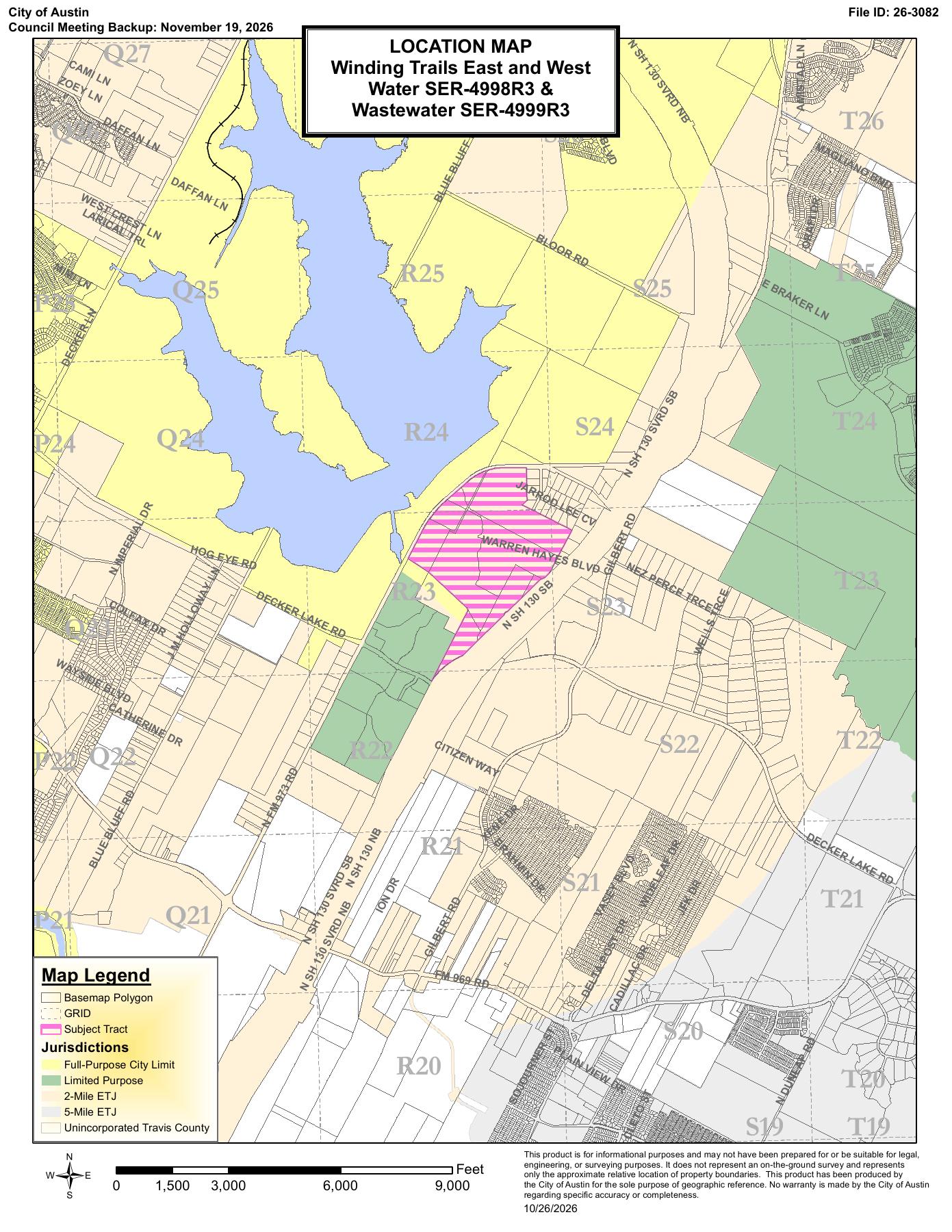
City Council will consider Nov. 19 two cost participation agreements with Z Modular to oversize water and wastewater lines serving a mixed-use project at FM 973 and State Highway 130.
The Austin City Council is set to consider two agreements on Nov. 19, 2026, under which the city would pay Z Modular up to $6.35 million to build larger water and wastewater lines than its proposed Winding Trails East and West development needs. The mixed-use project covers about 260 acres at 7308 N. FM 973, near the intersection with State Highway 130 in eastern Travis County. The items are listed on the consent agenda as Items 66 and 67, and both would be paid for from Austin Water’s capital budget.
The split is $1.85 million for water and $4.5 million for wastewater. Both agreements were listed for discussion and action at the Water and Wastewater Commission’s November 10 meeting. Minutes for that meeting were not posted at the time of review, so a commission recommendation is not confirmed here.
Development and utility scope
City documents describe a development of about 1,254 multifamily units, 195,000 square feet of office space, 205,000 square feet of retail space and 87,500 square feet of restaurant space. Plans also include a 16,500-square-foot event center, 115 hotel rooms and 14 acres of sports fields. The property is in ZIP code 78724, near City Council District 1. City staff say it sits entirely within Austin’s 2-mile extraterritorial jurisdiction, the city’s impact fee boundary, Austin Water’s service area, the Desired Development Zone and the Central water pressure zone. The council agenda lists the project as being in the city’s extraterritorial jurisdiction rather than in a council district.
Water service is covered by Service Extension Request No. 4998R3. Under that request, the developer would build about 4,650 feet of 24-inch water transmission main, which the city asked to be oversized so it can serve other properties in the Central pressure zone. The main would start at Decker Lake Road, run east along Decker Lake Road to State Highway 130 and then turn northeast along the highway to the property. The city would pay up to 33% of the hard costs of the 24-inch main and its fittings. It would also cover soft costs of up to 15% of its hard cost share, with total reimbursement capped at $1.85 million. Separately, the developer would pay for about 9,650 feet of 16-inch water main. That line would run north from Decker Lake Road along FM 973 to the property and then southeast through the site to connect with the 24-inch main along State Highway 130.
Wastewater service is covered by SER No. 4999R3. The site is in the Decker Creek watershed, and the city asked for larger wastewater facilities so they can serve other properties in the Decker Creek drainage basin. Three pieces would be oversized. The first is about 715 feet of 30-inch gravity wastewater interceptor along Decker Lake Road. The second is a 2,800-gallon-per-minute lift station south of Decker Creek near State Highway 130. The third is about 12,350 feet of force main running from the lift station west along Decker Lake Road to the 30-inch interceptor. The property alone would need a lift station with a capacity of 1,792 gallons per minute. The city would pay up to 40% of the hard costs of the 30-inch interceptor and up to 36% of the hard costs of the lift station, force main and fittings. It would add soft costs of up to 15% of its hard cost share, with total reimbursement capped at $4.5 million. The documents do not give a diameter for the force main.
The developer would build several gravity wastewater mains without a city cost share: about 1,300 feet and 3,250 feet of 15-inch main and about 2,250 feet and 3,400 feet of 12-inch main. The documents also refer to about 1,800 feet of 36-inch, 1,250 feet of 42-inch and 1,650 feet of 48-inch interceptor planned under the city’s separate capital improvement subproject 6943.061. Those lines are not part of this request.
Under the city’s standard terms, the developer would pay for financing, interest, fiscal security, accounting, insurance, inspections and permitting. It would also have to follow the city’s standard bidding practices, including the minority-owned and women-owned business procurement program in Title 2 of the City Code. Once the city gives final approval of the construction, the developer would hand the lines over to the city to own, operate and maintain. Staff say the city would share costs only to the extent of its proportional share, and that the oversizing fits the city’s long-range plans for the area.
Farther north along FM 973, the Texas Department of Transportation and the Capital Area Metropolitan Planning Organization are studying improvements between US 290 and Samsung Highway in Travis and Williamson counties. Early design plans were presented at a November 10 public meeting, with comments accepted through December 14. That study covers a different road segment from the Winding Trails site frontage.