
Google and Crusoe Advance Six-Building Project Llano in Claude
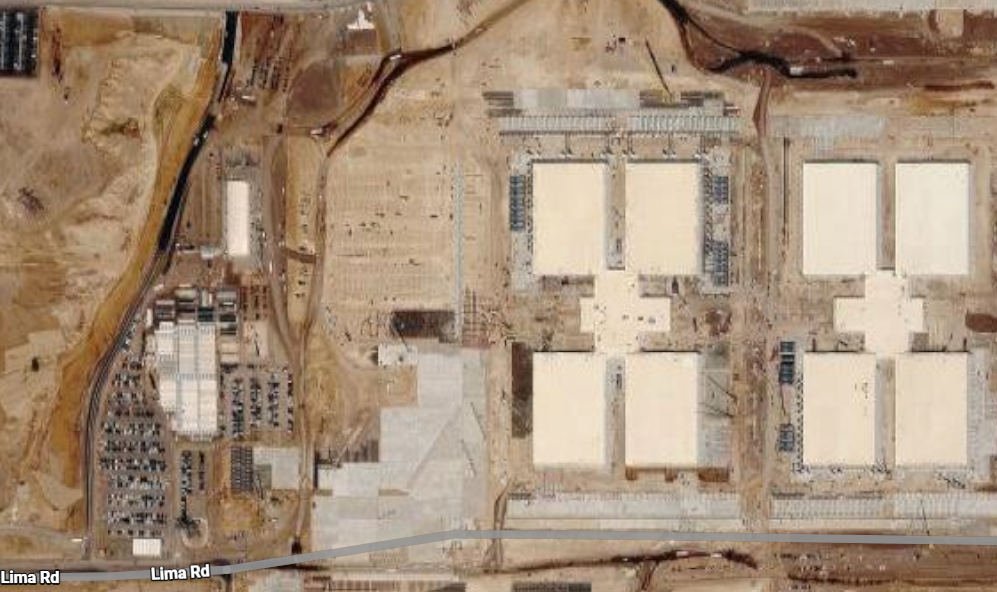
Project Llano spans more than 1,100 acres, with six data-center buildings and a stated capacity above 1GW. The first Google handovers are targeted for early 2027.
Google and Crusoe are advancing construction across six buildings at Project Llano in Claude, with the first handovers to Google targeted for early 2027. The campus is moving toward phased delivery as construction continues through the end of that year.
Project Llano is a data center campus under construction in Claude, east of Amarillo. Developed by Crusoe for Google, the Goodnight campus combines large computing buildings with the power, cooling and site infrastructure needed to support cloud services and artificial intelligence.
The site covers more than 1,100 acres. Six buildings are described in the current construction update, while published project information places the planned campus above one gigawatt. That is a development-scale capacity figure, not a measure of computing load already operating.
Project at a Glance
- Campus:
- Project Llano
- Estimated investment:
- $29 billion
- Developer and customer:
- Crusoe; Google
- Site:
- More than 1,100 acres at 10001 Lima Road, Claude
- Buildings:
- Six
- Building area:
- Approximately 4.19 million SF across six reported building filings
- Planned capacity:
- More than 1GW
- Construction workforce:
- More than 7,500 onsite
- First handovers:
- Early 2027 target
- Campus construction completion:
- End of 2027 target
A Campus Built at Industrial Scale
The six-building filing set described in earlier reporting comprises four buildings of 805,380 square feet each and two of 484,955 square feet each. Together, those areas calculate to 4,191,430 square feet. This is a total of reported building areas, not a measurement of server space or the full site footprint.
At this scale, delivery extends beyond the data halls. Roads, drainage, electrical distribution, cooling equipment and support accommodation must work as one campus. Different portions can reach enclosure, equipment installation and testing at different times, even when they share a common development name.
How to Read the Capacity and Investment Figures
The stated 1GW-plus scale describes the planned development. Earlier research cited in industry reporting modeled seven buildings and about 1.03GW, alongside a $29 billion investment estimate. The more recent community update describes six buildings. Those descriptions should not be combined into a single confirmed scope or budget.
The $29 billion estimate is a third-party projection rather than an owner-announced construction contract. Similarly, the $500 million registered for Building 3 is an individual package estimate. Neither figure establishes the value of work currently available to contractors.
Electrical capacity and building area also measure different things. Gross floor area includes offices and support rooms; megawatts describe an electrical scale. Neither indicates how many servers will be installed or when the entire campus will be operating.
Construction Timeline: Phased Handover Through 2027
State records for Building 3 list an October 21, 2025 start and January 29, 2027 completion. Earlier filings carried other package milestones during 2026 and early 2027. Those registrations record planned construction dates, rather than completed work or customer acceptance.
At the September 23 open house, Crusoe put the first Google turnovers in early 2027 and campus construction completion at the end of that year. The latest update therefore points to a phased delivery, with some buildings moving toward handover while others remain under construction.
A building handover is not necessarily the start of full computing operations. Electrical testing, cooling verification, controls integration and customer equipment installation can follow different schedules. The reviewed information does not establish a single date when all planned capacity becomes available.
Cooling, Utilities and the Site Workforce
Crusoe described closed-loop cooling, with water recirculating through the system. Officials projected annual operating use of roughly two million gallons per building. The company also reported more than 7,500 employees and craft workers onsite, making transport and workforce coordination significant parts of delivery.
Construction demand changes as the campus progresses. Earthwork, foundations and heavy deliveries dominate early stages; building services, equipment installation and testing become increasingly important as structures are enclosed. This sequence is an explanation of typical delivery requirements, not a claim that specific trade packages remain unawarded.
Building 3’s registration describes steel framing, insulated metal panels, curtainwall, offices, data halls and associated support space. Across a campus of this size, completing the buildings and proving that their electrical and cooling systems function together are separate milestones.