
Taylor Clears Path for Data-Center Campus With Up to 1 GW of Capacity
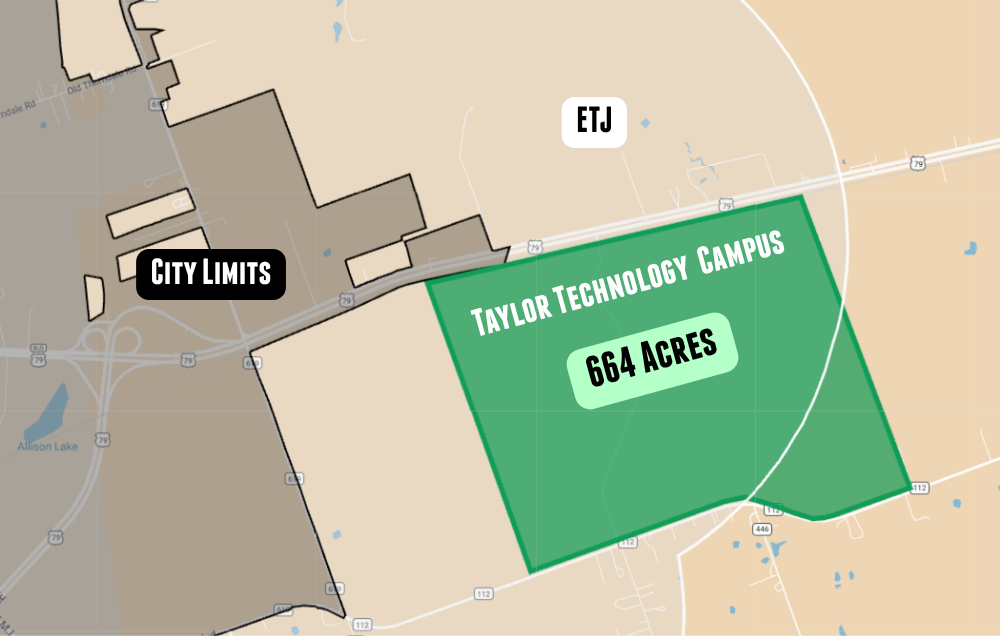
Big Watt Digital and PowerHouse have secured a development agreement for a 664-acre campus. Dedicated power generation and a first-power target in early 2028 put utility delivery at the center of the construction program.
A development agreement has advanced Taylor Technology Campus, bringing a large computing and energy proposal closer to delivery east of the city. Co-developers Big Watt Digital and PowerHouse Data Centers announced the approval on October 9, following the October 8 council meeting. Their plan combines computing facilities with dedicated generation rather than treating the electricity supply as a later addition.
The distinction between this approval and a construction start is important. The agreement establishes a framework for development; it does not, by itself, show that building permits have been issued, equipment has been ordered or a first data hall is under construction. For the construction market, the next evidence to watch is the conversion of that framework into engineered, permitted packages.
Project at a Glance
- Site:
- 664 acres
- Capacity ambition:
- Up to 1 GW
- Power target:
- First half of 2028
- Milestone:
- Development agreement approved; construction milestones still to follow
Power delivery sets the pace
The partners describe potential capacity of up to one gigawatt and target initial power availability in the first half of 2028. Their approach draws together on-site generation, natural-gas infrastructure, transmission access and data-center development. PowerHouse is a division of American Real Estate Partners.
The power program will be central to sequencing the campus. A finished building cannot support its intended computing load without an accepted electrical supply and commissioned distribution systems. Conversely, bringing generation online before the associated load requires its own operating plan. The useful schedule will therefore connect generation, electrical infrastructure and individual computing phases, rather than offer a single campus completion date.
First power also needs a defined boundary. It could describe an initial supply milestone without establishing the capacity available to every future building. The reviewed announcement does not provide a building-by-building energization schedule. Suppliers and prospective occupiers should distinguish the first operational phase from the full capacity ambition when assessing delivery risk.
A site plan shaped by water and neighboring properties
Taylor’s published project framework places the property between FM 112 and US 79. It calls for closed-loop cooling supplied with reclaimed water, with specified exceptions permitting potable water. Developers would fund utility connections and wastewater improvements. The framework also addresses setbacks, screening, drainage, lighting and noise.
For delivery teams, those provisions create interfaces between the campus and public infrastructure. The reclaimed-water connection needs to be coordinated with cooling-system testing and startup. A utility connection being physically complete is different from the service being available in the quantity and quality needed for commissioning.
Setbacks and screening also affect usable land. Gross acreage cannot be converted directly into a dependable count of data halls: access, utilities, drainage, separation distances and buffer areas all influence the buildable layout. A detailed site plan would show how the computing and generation facilities fit within those constraints and where construction access can be maintained as later phases proceed.
The city requires a traffic impact analysis before preliminary platting, covering both construction and operations. That makes haul routes and road improvements relevant early milestones. A campus can have modest routine operating traffic while still generating substantial temporary deliveries during civil works, structural erection and equipment installation.
Keep the economic forecast separate from the building budget
The developer release models a 2027–2029 construction period, approximately $4.8 billion in regional economic output and 19,000 construction-period full-time-equivalent jobs. Those figures describe modeled economic effects; neither is an announced construction contract value or a count of workers simultaneously on site.
This distinction matters when comparing Taylor with other announced campuses. An economic-output estimate includes activity beyond the direct cost of erecting buildings. Using it as a construction budget would exaggerate what has actually been disclosed and make comparisons with filed building estimates unreliable. A clearer procurement picture will require phase budgets or identifiable packages.
The same caution applies to a multi-year employment forecast. It helps describe expected regional activity, but it cannot establish peak craft demand, required accommodation or the size of a particular subcontractor’s workforce. Those questions depend on the number of phases running concurrently and the eventual delivery strategy.
What would turn the approval into a construction timetable
The next meaningful updates are a detailed phase plan, permit progress, utility delivery commitments and procurement appointments. TCH has not verified a general contractor or the mechanical, electrical or generation delivery teams for this campus. An unnamed delivery team should remain an open item rather than be inferred from the developers’ other projects.
The most useful future schedule would connect early civil work with utility availability, building completion and commissioning. It would also identify which shared systems must be sized for later expansion at the outset. That would let construction readers distinguish near-term work from capacity reserved for a longer buildout.
For now, Taylor has a developer-backed capacity target, a first-power objective and an approved development agreement. Together they provide a more concrete basis for tracking the project than an acreage announcement alone. They still leave the physical delivery sequence to be demonstrated through the next round of engineering, permits and contract awards.
Explore the project overview, dated updates and delivery milestones in Project Insights.
Explore project insights →