
Blue Origin Announces $555M Hutto Manufacturing Campus
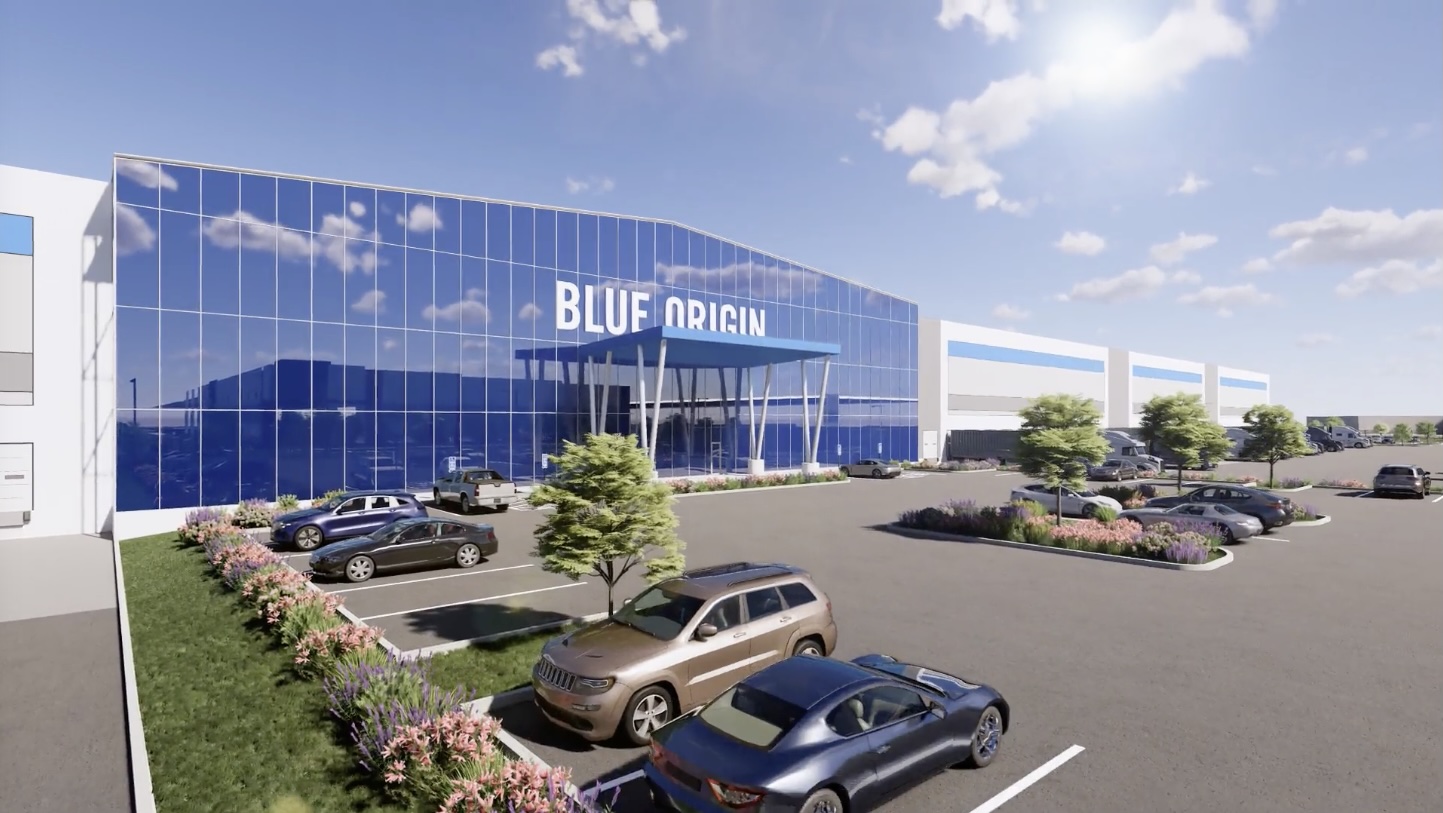
Constellation Park will bring 1.3 million square feet of satellite and communications manufacturing to Hutto. The $554.78 million investment adds a major aerospace production program to Central Texas’ construction pipeline.
Blue Origin has selected Hutto for Constellation Park, an advanced-manufacturing campus that will support its satellite and communications businesses. The company’s October 8 announcement sets out a multi-building complex totaling approximately 1.3 million square feet, giving Central Texas another large industrial development with a defined operating purpose.
The governor’s office puts the capital investment at $554.78 million. That is the announced investment in the campus, rather than a disclosed general-contractor award. Together, the owner’s manufacturing plan and the state’s investment figure establish the scale of a project whose individual construction packages and delivery appointments remain to be announced.
Project at a Glance
- Capital investment:
- $554.78 million
- Campus size:
- Approximately 1.3 million SF
- Configuration:
- Multiple facilities
- Employment target:
- More than 2,000 additional jobs over ten years
- State grant:
- $18.171 million Texas Enterprise Fund award
A production campus for space communications
The planned manufacturing mix extends from communications equipment to satellite components. Blue Origin identifies TeraWave and Quartz among the programs to be served, alongside production of solar arrays, avionics and other spacecraft hardware. Those functions explain why the announcement matters beyond the headline floor area: the buildings are intended to support an industrial production system, with different processes needing to work together.
TCH’s construction assessment is that the useful next level of detail will be how those functions are distributed across the campus. Building areas alone cannot establish the location of assembly lines, testing spaces, logistics functions or supporting services. A coordinated site and building program would help show which facilities need to be delivered together and whether parts of the campus could become operational before the entire development is finished.
The programs and people behind the campus
Blue Origin describes TeraWave as providing up to 6 terabits per second in both directions for enterprise, data-center and government customers. Quartz uses 3.7-meter antennas operating in S and X bands to communicate with low-Earth-orbit missions.
Blue Origin reported more than 550 existing employees across Texas when it announced the campus. Its state presence began with Launch Site One in 2006. Constellation Park is expected to add over 2,000 manufacturing and related positions over ten years.
What the investment figure tells us
Texas has extended an $18.171 million Texas Enterprise Fund grant and a $10,000 Veteran Created Job Bonus to Blue Origin. The state describes the Enterprise Fund as a performance-based economic-development program. These incentives are separate from the $554.78 million capital-investment figure; adding them together would not produce an announced construction budget.
For construction readers, the important distinction is between an economic-development commitment and the value of work available to builders. A capital program can involve property, buildings, production equipment and other investment. The reviewed announcement does not divide the total between those categories. It therefore supports the scale of the investment but cannot yet be used to calculate a reliable shell-construction rate or the value of a specific mechanical or electrical package.
The same discipline applies to employment. The owner’s jobs target extends across a decade. It is not a count of construction workers expected onsite at the peak of the build, and it does not mean all facilities will open simultaneously. Workforce growth and the physical delivery program need to be tracked as related but distinct measures.
Why Hutto matters to the construction market
The announcement places another major technology-related investment in Williamson County. The governor’s release connects Hutto’s growth to the Highway 79 corridor, while local officials emphasize the project’s effect on employment and the tax base. Blue Origin’s existing Texas presence dates to the establishment of Launch Site One in 2006; the Hutto investment adds a different production role to that footprint.
For the regional construction market, TCH sees the campus as a potential source of demand across building shells, site infrastructure and manufacturing fit-out. That is a scope-based assessment, not a list of contracts already offered. Aerospace production requirements must be established from the project’s actual design and procurement documents, rather than borrowed from a data center or another manufacturer’s plant.
The distinction matters in a region receiving several different kinds of industrial investment. A satellite-production campus, a semiconductor fab and a computing campus can all occupy large sites, but their equipment, operating conditions and commissioning requirements differ. The delivery strategy for Constellation Park should be assessed against the products it will make and the facilities it will contain.
From campus announcement to buildable packages
The next useful project records would identify the building sequence, utility interfaces and the boundary between base-building work and owner-installed production systems. Those details determine how a campus-level investment becomes a set of packages that can be designed, priced and delivered. They also help distinguish work required for initial operations from provision for future growth.
Site infrastructure can be consequential even when an announcement focuses on the buildings. Access, drainage and utility connections need to be coordinated with the final layout and operating requirements. TCH is not treating any particular substation, treatment plant or specialist process system as confirmed scope here: no such package has been established by the reviewed release.
Procurement intelligence will become more useful when it connects a named firm with a specific responsibility. A designer appointment, construction-management role and trade contract are different commitments. Until those are documented, assigning a company based on its previous work for Blue Origin elsewhere would risk giving readers the wrong project team.
The milestones that will show delivery progress
The owner announcement is the dated milestone for this update. The governor’s office describes the campus as being constructed, but the releases reviewed do not provide a detailed field-progress report, a dated groundbreaking ceremony or a final building-handover schedule. Those gaps should be resolved through project-specific updates rather than by inferring that the announcement marks the first day of site work.
TCH will follow the design and construction appointments, individual building filings, progress on site infrastructure and the first manufacturing-space handovers. Each adds a different piece of evidence: filings define scope, appointments explain delivery responsibility, and field updates show what has actually been built.
Constellation Park is already significant on the confirmed facts: a substantial capital commitment, a large multi-facility campus and an identified aerospace manufacturing purpose. The next chapter is how that investment is translated into a sequenced construction program and then into functioning production space. That is where the most useful contractor and project intelligence will emerge.
Explore the project overview, dated updates and delivery milestones in Project Insights.
Explore project insights →