
Oncor Advances Nearly $4B Power Corridor Spanning 424 Miles
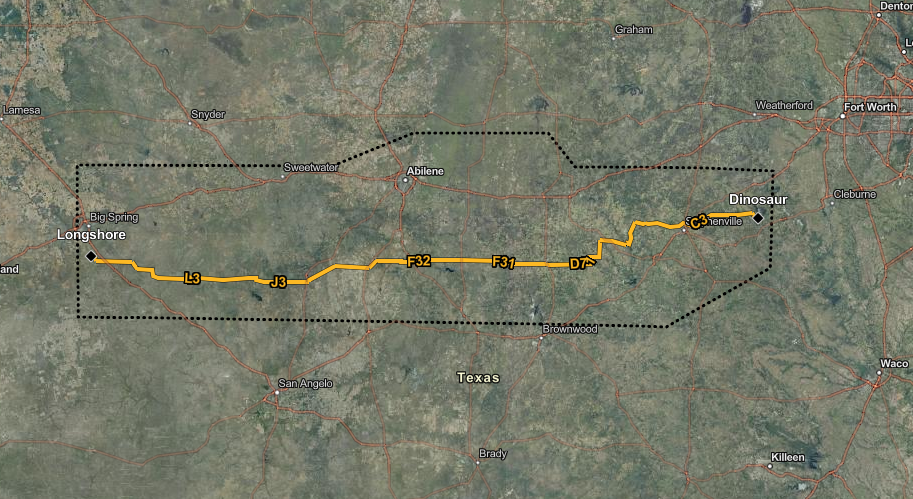
Two approved 765kV routes connect Somervell County with the Permian Basin. The estimated $3.95 billion program includes transmission lines and switchyards, with 2029 completion targets and rehearing requests still under review.
Oncor is advancing two connected transmission projects with a combined estimated cost of nearly $4 billion, creating an extra-high-voltage power corridor from Somervell County into the Permian Basin. Together, the approved Dinosaur–Longshore and Longshore–Drill Hole routes cover approximately 424.2 miles.
The projects form part of the wider Permian Basin Reliability Plan, intended to strengthen electricity supply as industrial activity, oil and gas operations and other large loads increase demand. Both routes received Public Utility Commission of Texas approval on August 28, 2026. That approval is an important development milestone; a confirmed start of main construction has not been established.
Project at a Glance
- Utility:
- Oncor Electric Delivery
- Combined estimated investment:
- Approximately $3.95 billion, including station work
- Approved route length:
- Approximately 424.2 miles across two projects
- Voltage:
- 765kV
- Route approvals:
- August 28, 2026
- Published completion targets:
- 2029 for both projects
Checking your membership…
Dinosaur–Longshore: 242.6 miles and $2.24 billion
The eastern segment connects the proposed Dinosaur Switch, about three miles north of Glen Rose in Somervell County, with Longshore Switch, west of Forsan in Howard County. The commission selected Route 559 under docket 59315. Its approved length is 242.56 miles, normally rounded to 242.6 miles.
The order records an estimated $1.704 billion for line construction and $538.765 million for station work, producing a total of $2.242769 billion. The station scope includes new 765kV switchyards at Dinosaur and Longshore. These are project estimates, rather than an announced construction contract.
Longshore–Drill Hole: 181.6 miles and $1.70 billion
The western project continues from Longshore to Drill Hole Switch in Culberson County, near the Reeves County boundary. The approved Route 476 covers approximately 181.6 miles under docket 59029.
Its estimated cost is $1.703882 billion: $975.821 million for line construction and $728.061 million for station work, including 765kV switchyards at Longshore and Drill Hole. Adding the two orders’ total estimates gives $3.946651 billion, or approximately $3.95 billion. The figure covers these two projects, rather than the entire statewide transmission expansion.
Towers, foundations and switching infrastructure
Both approvals describe single-circuit lines carried on self-supporting steel lattice towers, generally within a 200-foot right-of-way. Typical tower heights are approximately 155–160 feet, with variations for terrain and engineering requirements.
Delivering the corridor will require coordination of access, foundations, tower erection, conductor installation and station work. The switchyards are substantial parts of the program: long stretches of completed line will still need their terminal equipment and connections ready before the facilities can carry power.
Field assessments and detailed engineering remain important to the construction sequence. The orders address environmental resources, land use and the need to obtain applicable permissions. Route approval alone does not establish that every parcel, design package or workfront is ready for mobilization.
Approval, rehearing and the 2029 timetable
Oncor’s current project pages list 2029 completion for both segments. Earlier application schedules contain more specific assumptions, so those dated estimates should not be treated as a newly confirmed construction program.
An October 14 memorandum from PUCT Chairman Thomas Gleeson proposed extending the time available to consider rehearing motions in both dockets. The Texian Partisan reported that commissioners approved the extensions on October 15. The memo has been reviewed; the subsequent extension orders have not been independently retrieved.
The reported action gives the commission more time to consider the challenges. It does not by itself establish that either project has been canceled, that the approved route has changed or that construction has begun. Landowner engagement and right-of-way arrangements remain significant steps between approval and delivery.
Which companies will build the corridor?
The principal line-construction, foundation and switchyard contractors have not been verified in the material reviewed. The regulatory record does identify the consultants involved in routing and environmental assessment; those roles are distinct from contracts to build the lines.
Future award announcements, right-of-way progress and an updated construction schedule will show how this program moves into field delivery. The dedicated Project Insight brings together the confirmed planning team, individual cost components and dated milestones for both segments.
Explore the project overview, dated updates and delivery milestones in Project Insights.
Explore project insights →