
Houston Firms Plan Gas-Powered Floating Data Centers
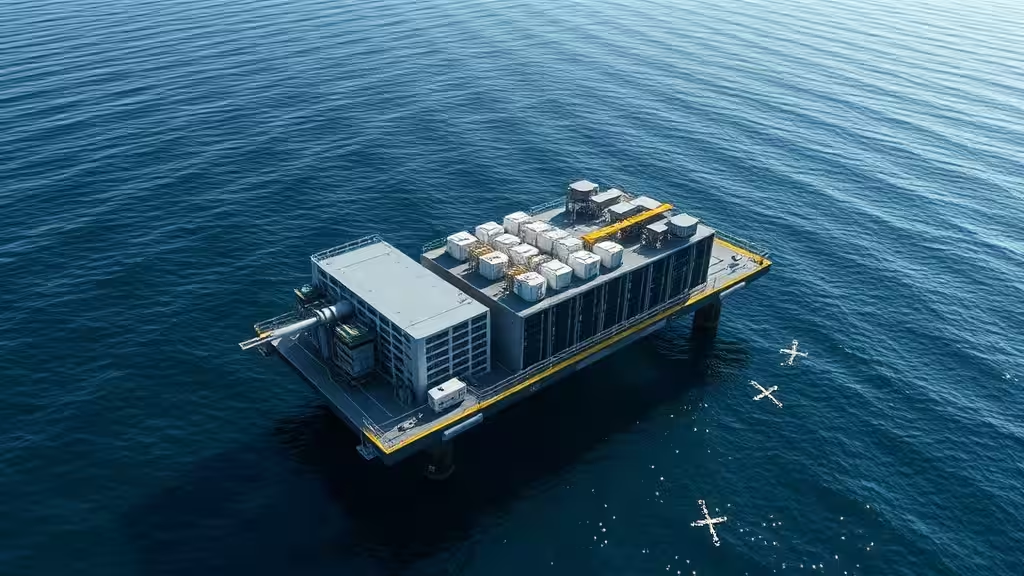
A new development partnership proposes offshore computing platforms powered by nearby natural gas. A first site, construction budget and delivery date remain unannounced.
Houston-based Riverway Group and Offshore Data Center have announced a partnership to develop offshore platforms that would generate electricity from nearby natural-gas resources and use it to power data centers. Their October 14 announcement proposes a different location for energy-intensive computing: close to gas that may be uneconomic to bring ashore.
The announcement is a development collaboration. It does not establish that a Texas offshore data center has started construction, secured a customer or reached a final investment decision. No committed project capacity or construction budget was disclosed.
Power and cooling built into the concept
The companies describe semi-submersible platforms combining natural-gas generation with modular computing facilities. Their cooling concept uses a closed loop linked to deep-ocean cooling, while the computing modules would support liquid-cooled GPU and CPU equipment. These are features of the announced design approach, not verified operating performance.
The proposal spans smaller inference applications and larger concepts of up to 1GW. That upper figure describes a possible configuration, rather than capacity financed, permitted or under construction. A specific project would still need a site, fuel arrangements, marine engineering, environmental approvals and a delivery program.
Putting the power source beside the computing load
The partners’ concept seeks to use stranded or undervalued gas at its source. Electricity generation and computing would be brought together offshore, rather than treating the gas resource solely as a fuel to transport to an onshore customer.
That changes the development questions. A viable project would need a defined gas supply, generation equipment, a marine platform, reliable communications and a site-specific cooling design. The announcement does not provide a complete engineering package or establish that those interfaces have been approved for a specific location.
A marine construction proposal, not a conventional campus
Floating infrastructure would need to address access for installation and maintenance, the marine environment and the operating requirements of the computing equipment. These considerations explain why a partnership announcement is an early step rather than evidence of a completed project design.
The companies describe combining platform-design relationships with fabrication capabilities. A final hull configuration, offshore site, customer commitment and fabrication schedule have not been established in the material reviewed. Those details will determine how the concept translates into a practical construction program.
What would make the proposal construction-ready
The next meaningful milestones are a named pilot site, confirmed power and computing capacity, engineering definition and a delivery timetable. A financing decision and the relevant offshore permissions would also make the commercial proposition more concrete.
For now, the partnership shows Houston firms pursuing an overlap between offshore energy and digital infrastructure. It creates a project-development lead to follow, without supporting claims of an awarded gigawatt-scale campus or an imminent offshore construction start.