
AMD Backs Fermi’s 222MW Texas Lease as Expansion Framework Reaches 650MW
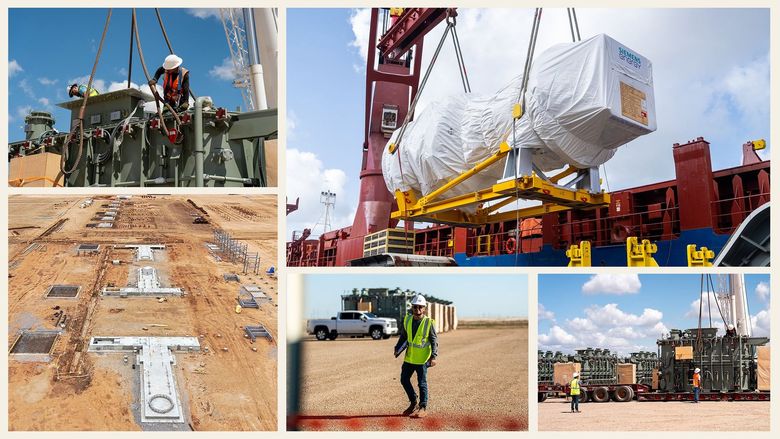
AMD credit support strengthens the financing path for TensorWave’s initial lease at Project Matador. A larger framework remains conditional, with initial delivery targeted for the second half of 2027.
Fermi America has secured an agreement with AMD supporting the credit behind its initial 222MW lease with TensorWave at Project Matador in Carson County. Announced October 13, the arrangement addresses a central question facing the development: how to turn a large computing commitment into a financeable program of buildings, power infrastructure and phased delivery. The companies also established a framework for potential expansion to 650MW across future phases.
The agreement strengthens the commercial foundation beneath a major Panhandle construction program, but it does not announce completed project financing or a fresh construction contract. Those distinctions are material. A customer lease, a credit-support arrangement and a financing close perform different jobs, and each affects when a developer can confidently commit capital to the next stage of delivery.
Project at a Glance
- Initial lease:
- 222MW of facility power
- Expansion framework:
- Potential 650MW
- Contracted revenue:
- Approximately $6.5 billion over 15 years
- Initial delivery target:
- Second half of 2027
A credit agreement behind a physical construction program
A credit backstop can make a long-duration lease more useful to lenders by addressing the risk that the tenant cannot meet its obligations. It does not remove construction risk. Buildings still have to be designed, permitted, equipped, tested and accepted; supporting energy infrastructure must be ready when the computing space needs it. The practical significance of the AMD arrangement is therefore its potential to support the funding process, rather than evidence that every element of the campus is now funded.
Fermi’s announcement identifies remaining conditions around the lease and financing process. For construction businesses, the next meaningful distinction is between a commercial agreement that improves the probability of work and financing that enables a defined package to proceed. A project of this scale can generate substantial preparation activity well before all major packages reach that second point.
What the TensorWave lease actually covers
The underlying lease announced August 10 provides approximately $6.5 billion of contracted revenue over 15 years, with two five-year renewal options. That figure describes anticipated lease receipts across time; it is neither a construction budget nor an upfront payment. The initial 222MW refers to facility power, so it should not be presented as an equivalent quantity of critical IT load.
The initial deployment is targeted for phased delivery in the second half of 2027. TensorWave’s planned use of AMD computing technology connects the hardware ecosystem to the tenant relationship, while the potential expansion would extend the development across additional phases. The 650MW framework should be read separately from the initial binding lease: a framework establishes a route for further business, rather than proving that the expanded capacity is already under construction.
Power and buildings have to reach the same milestone
Project Matador’s broader proposition is to develop energy infrastructure alongside AI facilities. That creates interdependent construction programs. A completed building without dependable power cannot serve its intended computing load, while generation equipment alone does not deliver a commissioned data hall. Electrical distribution, cooling, controls and operational testing sit between those two endpoints.
From a delivery perspective, the critical path may move between workstreams as design and procurement advance. The longest building activity is not necessarily the activity controlling first service. Equipment availability, installation readiness, energization and integrated testing can determine when a tenant can accept space. A useful future schedule would therefore identify hall-level handovers alongside the infrastructure needed to support each handover.
This is also why a campus-wide megawatt figure is a poor substitute for a phase-specific construction baseline. The first phase needs its own boundaries: which buildings, which power assets, which utility interfaces and which completion criteria are included. Those details allow prospective suppliers to distinguish immediate requirements from the much larger development ambition.
The wider campus remains a long-term ambition
Fermi markets Project Matador as a planned 17GW energy and AI campus near Amarillo and says it has invested more than $1.5 billion in the development. The campus originated through a relationship with the Texas Tech University System, placing a substantial private infrastructure proposal within the region’s wider energy and research economy. The long-term scale is a development plan, not a statement of operating capacity.
The initial TensorWave commitment should therefore be assessed on its own delivery evidence. Progress against a first customer’s requirements can establish a repeatable model for later buildings, but it does not automatically authorize the rest of a large master plan. Future phases will need their own customer commitments and the infrastructure, approvals and capital required to support them.
How the announcement changes the construction outlook
The clearest immediate change is commercial rather than physical: a major technology supplier is now providing support connected to the initial tenant agreement. That can help advance the conversations required to fund construction. It does not identify a newly awarded general-contractor, mechanical or electrical package, and the announcement should not be used as evidence of one.
For contractors assessing the opportunity, a more dependable sequence is to establish which phase is funded, identify the contracting entity, confirm that procurement has been released and then examine scope interfaces. On a combined energy and computing campus, the boundary between site infrastructure, power works and building systems is especially consequential. An attractive campus headline is not enough to establish who owns a particular package or when bids are due.
Why phased acceptance matters to the first lease
A phased handover allows the first usable capacity to enter service while later areas remain in construction. It also requires the project team to define the boundary between an operational facility and a continuing work site. Access, isolation of building systems and the sequence of tests become part of the delivery plan, rather than tasks left until the entire campus is finished. For Matador, the announced second-half 2027 window is most informative when paired with those phase boundaries.
There is a commercial reason for that level of detail. A lease can be signed long before a tenant accepts a hall, and construction expenditure can precede rental receipts. The developer therefore needs funding that supports the work through the interval between commitment and service. AMD’s credit support addresses the customer side of that equation; it does not replace the construction funding or the evidence that each phase has met its acceptance requirements.
Milestones that would turn the framework into delivered capacity
The next updates to watch are completion of the financing process, satisfaction of the relevant lease conditions and a clearer phased delivery baseline. Construction reporting should then connect verified field milestones to the initial 222MW commitment rather than the full 650MW framework or 17GW campus ambition. That makes progress measurable without inflating the portion being delivered.
A further expansion announcement would be more consequential if it specifies a binding customer commitment, the capacity included, the facilities required and the corresponding funding and delivery dates. Until then, AMD’s support is a significant step in the project’s commercial development, with its ultimate construction impact dependent on the commitments that follow.
Explore the project overview, dated updates and delivery milestones in Project Insights.
Explore project insights →