
$143M in Preliminary Filings Outlines Westlake Data-Center Work
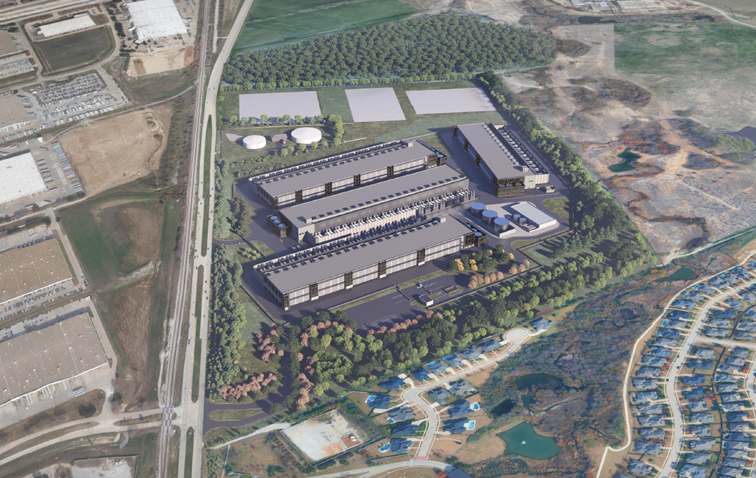
Three registrations divide a proposed DAL130 package into a main building, water infrastructure and access control. The estimates sharpen the picture of planned work without establishing a construction award.
PowerHouse Data Centers’ proposed Westlake campus has acquired a more detailed paper trail. Three Texas accessibility registrations associated with DAL130 at 13572 North Main Street carry a combined estimated construction cost of $143 million. They describe a main data-center building and two support facilities, giving construction readers identifiable scopes to track as the wider Circle T Ranch proposal advances through planning.
The distinction between a registration and a construction commitment is central to this update. The records list a December 1, 2026 start and June 1, 2027 completion. Those are dates supplied by the registrant. They do not establish that local permits have been issued, that a contractor has received a notice to proceed or that the entire campus can be completed within six months.
Project at a Glance
- Combined filed estimate:
- $143 million across three registrations
- Main building:
- 224,152 square feet
- Support buildings:
- 5,000 and 1,500 square feet
- Filed schedule:
- December 1, 2026–June 1, 2027; not a verified construction program
Checking your membership…
Three scopes, rather than three computing buildings
The largest registration, TABS2027002672, carries an $83 million estimate and a stated floor area of 224,152 square feet. It is the main data-center component of this group. A second record, TABS2027002674, assigns $45 million and 5,000 square feet to an auxiliary water building. The third, TABS2027002675, lists $15 million and 1,500 square feet for access control. Together, the submitted areas total 230,652 square feet.
These figures should remain attached to their individual scopes. Dividing the $143 million total by the main building’s area would blend computing space with separate infrastructure and produce a misleading comparison with a conventional warehouse or office shell. The small floor areas of the support buildings also mean their estimates cannot sensibly be interpreted through floor area alone. The registrations do not provide an equipment-level cost breakdown.
All three records identify Circle T Owner LP as the owner and leave the tenant unassigned. That supports a common project connection but does not identify an ultimate computing customer. Neither an owner name nor a campus marketing plan is enough to allocate a particular building to an operator. The reviewed records also do not establish a general-contractor award.
The building filings sit within a larger campus proposal
Earlier reporting by Data Center Dynamics described a roughly 88-acre PowerHouse proposal at Circle T Ranch, with four larger data-center buildings and potential campus capacity of 300 megawatts. That is the broader development concept. The three October registrations include support structures and should not be presented as a replacement count for those four planned computing buildings.
The same reporting placed the site near US 377 and described a planning submission in August. PowerHouse is part of American Real Estate Partners and has been expanding its Texas development pipeline. The company’s other projects demonstrate its regional activity, but their contractors, occupiers and delivery arrangements cannot be carried across to Westlake without project-specific evidence.
For readers comparing proposals, the key is to keep three measures separate: the land and ultimate capacity of a campus, the buildings covered by a particular filing, and the phase actually released for construction. Westlake now has more detail in the second category. The public records reviewed for this update do not yet reconcile that detail with a complete, funded buildout sequence.
Planning and local permissions still matter
Recent reporting carried by iRecruit quotes PowerHouse describing the development as being in planning and review, subject to approvals. It also describes continuing local proceedings affecting the proposed development. TCH has not independently established a final resolution of those proceedings or a permit release; the filed December date should therefore remain a target rather than be reported as a confirmed mobilization date.
That uncertainty is practical for construction teams. Accessibility registration is one part of a project’s administrative record. It does not replace the local decisions, engineered utility arrangements and contractual instructions required to deliver the work. A useful follow-up would identify which approvals remain open and whether the main building and support facilities will proceed under one coordinated phase or separate packages.
Why the support infrastructure deserves attention
The water and access-control scopes are important indicators of campus planning, even though they occupy far less floor area than the main building. Shared systems can determine when a computing facility becomes usable. Their engineering, installation and acceptance need to align with the building they serve, rather than be treated as incidental work at the end of a program.
The water building’s $45 million filed estimate is particularly significant within this group, but the record does not reveal exactly how that sum is divided between structure, equipment and associated connections. It would be premature to convert the estimate into a specific cooling-system procurement opportunity. An issued scope or equipment schedule would provide a firmer basis for assessing the work.
Access arrangements also influence sequencing. Construction deliveries, permanent security boundaries and later operating access need to coexist during phased development. That is a general delivery consideration, not a claim that a particular security system or site-logistics plan has been approved for DAL130.
The next evidence to watch
The most useful next milestones are local permit decisions, revisions to the registered dates, a phase-specific power and water program, and confirmed delivery-team appointments. An update identifying the first building to be energized would also be more informative than repeating the ultimate campus capacity.
For now, the $143 million total is best understood as the sum of three preliminary registered construction estimates. It gives the market a clearer view of intended building and infrastructure work at Westlake while leaving the contract values, customer allocation and operational timetable to subsequent evidence.